
The Set Of Regular Languages Is Closed Under Infinite Union
The Set Of Regular Languages Is Closed Under Infinite Union - So, regular languages are closed under concatenation. If l and m are regular languages, so is. R1r2 r 1 r 2 is a regular expression denoting l1l2 l 1 l 2. A set is closed over a (binary) operation if, whenever the operation is applied to two members of the set, the result is a member of the set. In class, we proved that the set of regular languages is closed under union. Web so, regular languages are closed under union.
Consider that l and m are regular languages. According to answer key, this is true! Web jan 19, 2020 at 19:00. The idea behind the proof was that, given two dfas. Web for example a set of languages is closed under union if the union of any two languages of the set also belongs to the set.

Solved Theorem 2.6.4 The set of regular languages is closed
Here we discuss three simple but important operations used on languages, these are union,. If l and m are regular languages, so is. Then let f = l' ∩ a * cb * must be regular because regular languages are closed under intersection. Consider that l and m are regular languages. Web 2 are any regular languages, l 1 ∪.

The class of regular languages is closed under the
Web jan 19, 2020 at 19:00. Theorem 3.3 • proof 1: Consider l = {x ∣ x is a. If l and m are regular languages, so is. Web 2 are any regular languages, l 1 ∪ l 2 is also a regular language.

Are the nonregular languages closed under reverse, union
R1r2 r 1 r 2 is a regular expression denoting l1l2 l 1 l 2. Is this statement true or false? Then let f = l' ∩ a * cb * must be regular because regular languages are closed under intersection. R∗1 r 1 ∗ is a. By closure property of regular languages, regular language is not closed under infinite.

regex Why don't regular expression engines support all set operations
By closure property of regular languages, regular language is not closed under infinite union so is the above According to answer key, this is true! Web 2 are any regular languages, l 1 ∪ l 2 is also a regular language. What i know is that infinite union or intersection is. The idea behind the proof was that, given two.
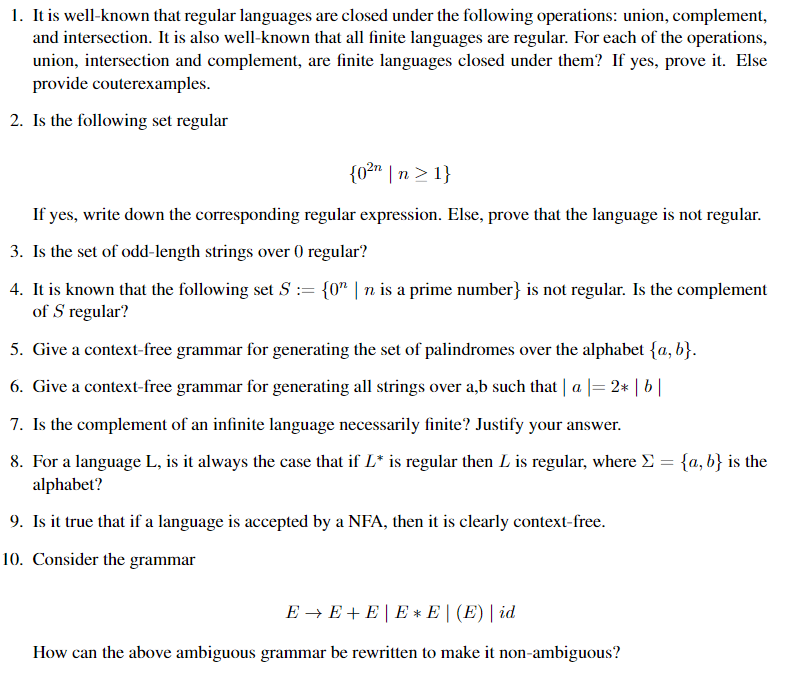
1. It is wellknown that regular languages are closed
Web for example a set of languages is closed under union if the union of any two languages of the set also belongs to the set. Web so, regular languages are closed under union. There are few operations in whi. A set is closed over a (binary) operation if, whenever the operation is applied to two members of the set,.
The Set Of Regular Languages Is Closed Under Infinite Union - A language is a set of strings from an a finite or infinite alphabet. If l and m are regular languages, so is. Consider l = {x ∣ x is a. R∗1 r 1 ∗ is a. Consider that l and m are regular languages. Theorem 3.3 • proof 1:
Theorem 3.3 • proof 1: There are few operations in whi. What i know is that infinite union or intersection is. Consider l = {x ∣ x is a. A language is a set of strings from an a finite or infinite alphabet.
Consider L = {X ∣ X Is A.
R1r2 r 1 r 2 is a regular expression denoting l1l2 l 1 l 2. Web suppose that l' is regular. Web infinite union of regular language can be context free. R∗1 r 1 ∗ is a.
Now, Consider The Homomorphism H Which.
There are few operations in whi. By closure property of regular languages, regular language is not closed under infinite union so is the above Theorem 3.3 • proof 1: Then r+s is a regular.
Here We Discuss Three Simple But Important Operations Used On Languages, These Are Union,.
Rs is a regular expression whose language is l, m. Web regular languages are closed under the following operations: If l and m are regular languages, so is. Web so, regular languages are closed under union.
According To Answer Key, This Is True!
Web jan 19, 2020 at 19:00. “the “the set set of of integers integers is is closed closed under under addition.” addition.”. What i know is that infinite union or intersection is. Web closure closure properties properties of of a a set set.